What Does a Real Solution Look Like for Auckland Drive?
The debate over Auckland Drive has often been presented as if there are only two choices: keep struggling with the existing collections, or move to communal bins in the road. But the council’s own options papers show that isn’t true. There were at least six options on the table, and the documents reveal two alternatives that deserve far more attention than they received: Option 1 and Option 2.[Options Appraisal, 26 June 2025]
Option 1 keeps collections at the properties, but with clear, site-specific instructions, better resident communication, and the glass boxes converted to 140L bins. Option 2 does something even more practical: bins are collected and then only partly returned to a designated point on the slopes, so residents bring their empty bins back up themselves. Both options preserve the current kerbside-style model, avoid putting communal bins into parking bays, and keep the street closer to how residents already live with the route.
The real question is why those options were not pursued more seriously. If the council’s own Highways team warned that Option 4 was unsafe — saying it was not appropriate to place bins in a live carriageway, that it could block the road, and that the bins might not be visible at night — why was that still treated as the preferred option?[Highways response, 30 June 2025] Was the deciding factor really safety, or was it cost and convenience?
Options 1 and 2: the overlooked middle ground
The June 2025 options appraisal is unusually revealing because it doesn’t just present a single “solution”; it lays out a spectrum. Option 1 requires crews to continue collecting directly from the properties, using a site-specific method statement and improved bin presentation. Option 2 goes a step further and reduces some of the carrying burden by having empty bins left at a designated point part way up the slopes.
That matters because the whole justification for communal bins was the manual-handling burden on staff. But if the actual problem is the effort of lifting and carrying bins up and down steps and slopes, then a mixed approach may be enough: let residents bring bins down where they can, use a method statement where they can’t, and adapt the route so the crew only use the provided ramps or slopes.
The council’s own later emails show that by February 2026, the Health & Safety Adviser was reporting that most residents already bring their bins down to the road, and that this “significantly reduces the number of trips along the path and stairs to collect bins”. They go on to say that if residents are doing this, it would “eliminate some of the musculoskeletal hazards” and that residents will understandably argue there is no need to change if operatives are no longer navigating the slopes.[FOI-23386117, 19 Feb 2026] In other words: the lighter-touch “solutions” the council talked about on paper were already happening in practice.
That is the kind of real-world compromise that should have been tested properly before moving to a more disruptive model.
Why was Option 4 really chosen?
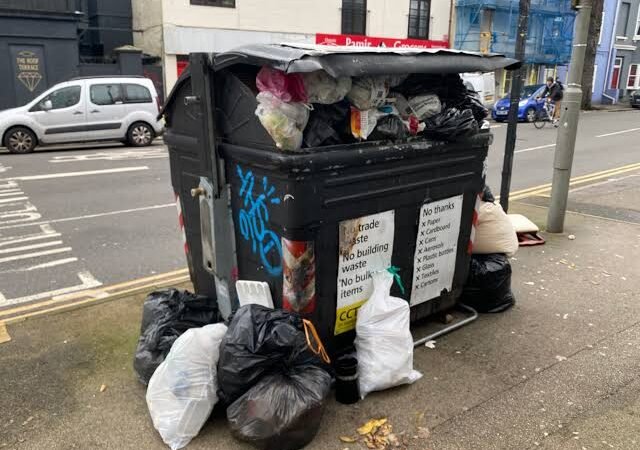
Option 4 is the one that moves communal bins into roadside parking bays. It was favoured in the internal papers, but it came with obvious trade-offs: loss of parking, greater visual intrusion, potential obstruction, fly-tipping, and the Highway’s explicit warning that it could create hazards. Yet it remained “preferred”, and even when Highways proposed Option 5 (cutting safe bin stores into the bank) as the safer alternative, that was sidelined as potentially too expensive.
The options appraisal itself talks openly about time savings, reduced crew requirements, and fewer delays to traffic. It is hard to avoid the conclusion that Option 4 won because it is cheaper and simpler to operate, not because it is the safest or fairest option for residents.
That may be administratively attractive, but it is not the same thing as being the best solution for Auckland Drive. If a route can be made workable with Option 1 or 2, then a more disruptive option should require much stronger justification than “it’s easier and cheaper”.
That is the core issue here. The council says it is listening, but if the result is a scheme that residents experience as imposed, while safer, less disruptive alternatives are left on the shelf, then “listening” starts to look more like managing opposition than genuinely changing course.
What a better solution could look like
A better solution would start with the street as it is, not the street as the council wishes it were. It would:
- Keep kerbside collection as the default, rather than defaulting to roadside communal bins.
- Use Option 1 or 2 style arrangements to reduce manual handling where it is genuinely needed.
- Recognise that many residents already bring their bins down to the road and build around that, rather than punishing everyone with a one-size-fits-all scheme.
- Convert steps to ramps at key points where that clearly improves safety and access.
- Require workers on the route to use the provided ramps and agreed paths, enforced by a clear, site-specific method statement.
- Reassess the need for communal bins only if, after trying these measures, the evidence shows that the risks and effort are still unacceptably high.
None of this denies that Auckland Drive is a challenging route. The September 2024 H&S report, and the later risk review, are right to flag steep banks, long walking distances and the potential for slips, trips and strains. But a serious safety problem does not automatically justify the most disruptive solution, especially when the council’s own documentation shows there were more proportionate options on the table.
Questions residents should keep asking
Residents are entitled to keep asking some very simple questions:
- If residents are already bringing bins down to the road, and crews are only required to use ramps and safe routes, what specific risks remain that cannot be managed under Options 1 or 2?
- Why did the council continue to push Option 4 after Highways formally advised that putting bins in the live carriageway was “not appropriate and not the right solution”?
- Where is the transparent comparison of long‑term costs and safety outcomes between keeping kerbside-style collections (with improvements) and installing roadside communal bins?
Those are not anti‑safety questions. They are the questions you ask if you take safety seriously — and expect the council to do the same.
The documents suggest there was another path available all along. The only real question now is whether the council is willing to take it.