Assisted collections: what Auckland Drive residents were told
Update – August 2026: Since this post was first published, Brighton & Hove City Council’s Corporate Director for City Operations has confirmed in writing that residents who need an assisted collection “will be provided with one”.
This is a welcome assurance. The Director says that forthcoming discussions with residents are intended to ensure appropriate arrangements remain in place for people who need assistance accessing communal bins. Residents are now seeking clarity on how those arrangements will work in practice, whether current users will experience any interruption, and how future requests for assistance will be assessed.
Source: Email from Corporate Director, City Operations, Brighton & Hove City Council, August 2026.
For many residents, assisted bin collections are an essential service. They allow people who cannot safely move their bins – for example because of age, disability or health conditions – to have their waste collected from an agreed point.
When the Auckland Drive communal bin proposal was first set out to residents, the information letter reassured
people that if they currently receive help with their bin collections, this would “continue as usual,” even though
the new scheme would also involve removing their existing household bins at the same time.
Source: Initial information letter to Auckland Drive residents, 2025.
What internal emails say about the future of assisted collections
Internal correspondence released under Freedom of Information shows that officers were already discussing a different approach for assisted collections.
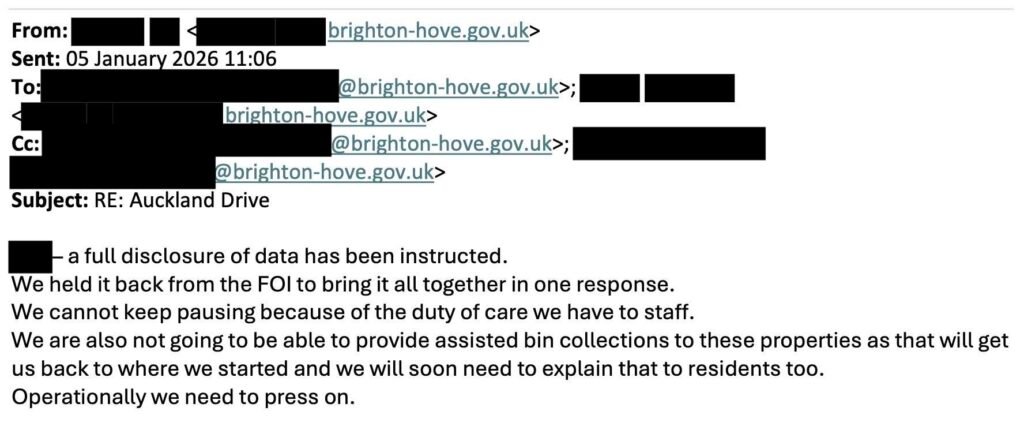
In an email dated 5 January 2026, an officer advises councillors that the council
“will not be able to provide assisted bin collections to these properties” under the new arrangements and that this
would need to be explained to residents.
Source:
FOI‑23386117 – All emails, Part 1
, email 5 January 2026.
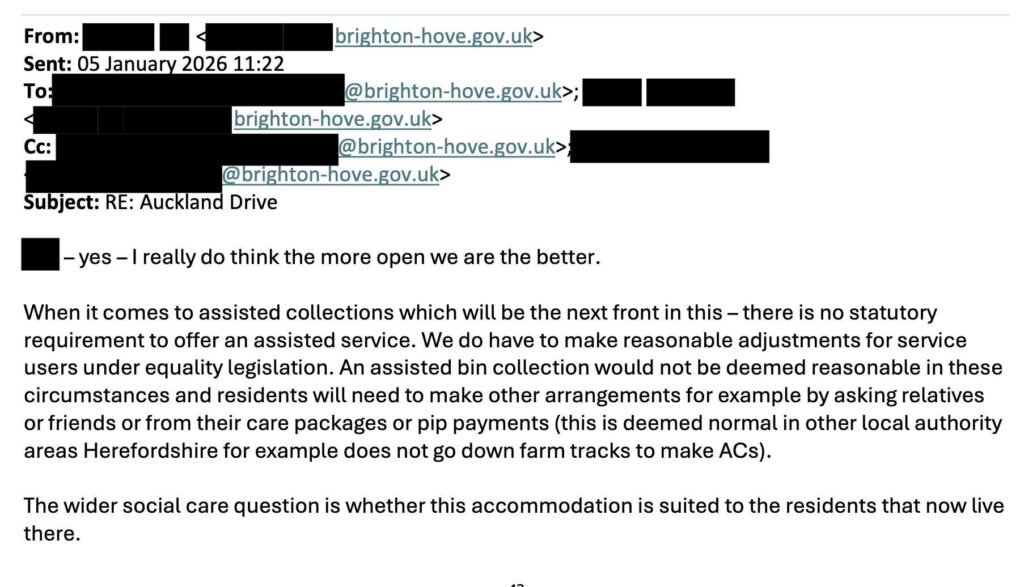
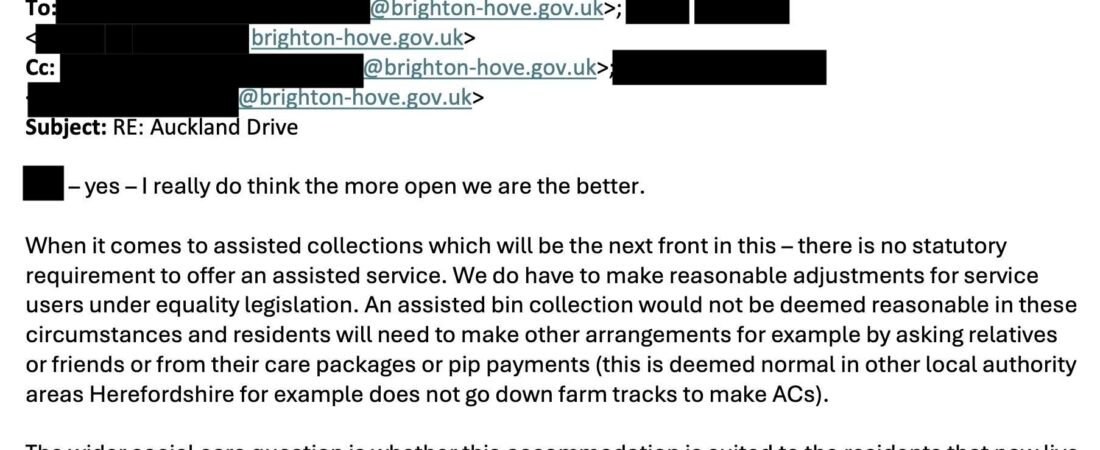
A further email the same day describes assisted collections as “the next front in this,” noting that there is no
specific statutory requirement to offer an assisted collection service and that in these circumstances it would
“not be deemed reasonable.” The email suggests that residents may need to make other arrangements, for example by
asking relatives or friends, or through existing care packages or disability benefits, and raises a wider question
about whether the accommodation is suited to the people who now live there.
Source:
FOI‑23386117 – All emails, Part 1
, email 5 January 2026.
Why this matters for the wider community
Taken together, the resident letter and the internal emails highlight an important gap between what vulnerable residents believed would happen to their assisted collections and what was being considered operationally behind the scenes.
The Director’s August 2026 assurance is therefore important. It provides a clear written commitment that residents who need an assisted collection will be provided with one. The remaining issue is making sure this commitment is translated into clear, practical and reliable arrangements before any change is implemented.
For Auckland Drive residents, the earlier internal correspondence created understandable uncertainty: people who rely on assisted collections had been told their support would continue, while internal discussions explored withdrawing that support and directing residents to make other arrangements. The later written commitment should now be followed by a clear explanation of exactly what support will be available and how residents can access it.
For the wider community, the Auckland Drive experience is a reminder to look closely at how changes to bin systems interact with support for residents who need extra help. As councils review waste services and trial new models, it will be important for any future consultations to explain clearly what will happen to assisted collections, and to make sure that people who depend on them have a chance to understand, ask questions and give feedback before changes are made.
Internal FoI Emails showing the intent to remove Assisted Collections