Why this report matters beyond Auckland Drive
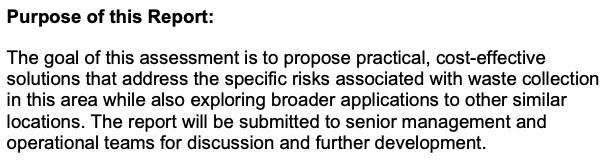
In 2024 the council commissioned a health and safety assessment for waste collections on Auckland Drive. The stated purpose was not only to look at the specific risks on that road, but also to “propose practical, cost‑effective solutions… while also exploring broader applications to other similar locations.” In other words, Auckland Drive is being used as a case study for how collections might be managed on other, similar streets in future.
An important detail is that less than half of Auckland Drive is described in the report as having “slopes, banks, ramps, steps.” Despite this, the proposal is for the whole street to move to communal bins. This is happening even though most residents already take their bins down to street level on collection day, which reduces the need for crews to pull heavy bins up or down inclines.
This change in resident behaviour is also recognised by the council’s own Health & Safety team. On 19 February 2026, after accompanying the crew on the round, the Corporate Health & Safety Advisor reported internally that “most residents bring their bins down” and that this “significantly reduces the number of trips along the path and stairs to collect bins.” They went on to state that if staff no longer need to bump bins up and down stairs, “this would eliminate some of the musculoskeletal hazards,” and questioned whether there was still a need to change the current system in light of this.
The council has also indicated that the 2024 health and safety report was prompted by reported incidents in the area. However, when members of the public asked to see the underlying safety evidence in early 2026, Corporate Health & Safety and Environmental Services reviewed the accident‑book entries for Auckland Drive. The released FOI material shows that only two relevant incident reports in the previous ten years could be evidenced, despite public statements referring to “numerous” injuries and near‑misses on the route. Internal emails discuss whether they can “release the incidents from the accident book” and confirm that existing documentation is limited, which then prompted a new risk‑assessment exercise.
The Project Mandate for the Auckland Drive scheme lists two primary goals, one of which is to “Reduce the number of reported injuries.” In practice, there have been only two reported injuries in over a decade, both minor and both assessed as avoidable had proper procedures been implemented and followed. This raises reasonable questions about whether a street‑wide change to communal bins is a proportionate response to the recorded evidence.
For residents elsewhere in the city, this is worth being aware of. If the approach chosen on Auckland Drive is communal bins for an entire street – even where only part of it is steep, and where many households already assist by moving their bins – the same model could be considered for other roads with some homes on an incline or with constrained access.
The aim of sharing this information is not to cause alarm, but to help people understand how decisions made in one location can influence what happens in others. If your street has any sections on a slope, or similar collection challenges, it may be included in future reviews. Being informed now means residents are better placed to ask questions, give feedback and take part in any consultation that might affect their own area.
Sources:
19 February 2026 H&S email:
FOI-23386117-All-emails_Part1-REDACTED.pdf
, p.23, Health & Safety Advisor.
Early 2026 incident review and Project Mandate references:
FOI-23386117-All-emails_Part2-REDACTED.pdf
, pp.4–6.